Last Saturday, my family and I went to our favorite bookstore. We hadn’t been in a few months. That happens. Life and a hundred other things tend to fill up the weekends, and before you know it, it’s been a while since we last walked through those doors. We came in together and, as always, scattered. Everyone drifted off into their own little world.
For me, even after decades in the book world, I end up going up and down the aisles a lot like I grocery shop. I start at the new releases, the ones pulled together from every genre, new in fiction, mystery, biography, history. Every single time, there’s something I haven’t seen, an author I don’t know yet. And then I assume the position. Head tilted at that particular angle so I can read the spines, scanning up and down, until a title grabs me. I pull it out, read a little, maybe snap a picture for my to be read list, and slide it back. Then I move on, one genre into the next.
And somewhere in that slow walk I remembered what I do when I can’t get to the bookstore but I still want this experience. The browsing itself, that unhurried feeling of moving through the shelves with no particular place to be.
The bookstore on my shelf
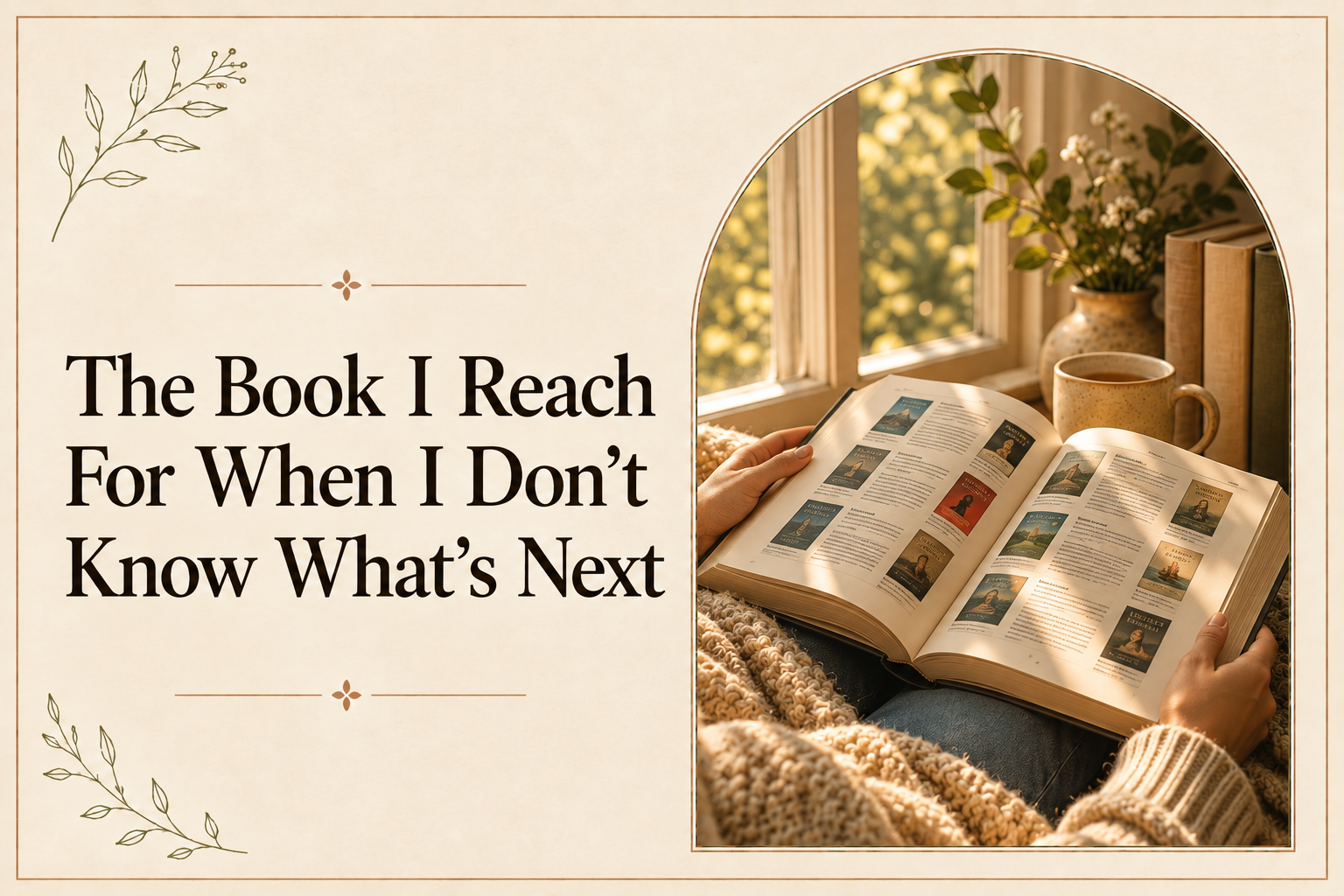
It’s been on my shelf for years: 1,000 Books to Read Before You Die by James Mustich. I got it as a Christmas gift, probably back in 2018 or so. Every year, I put together a Christmas wish list of books, so when someone asks what I’d like, I have a few titles ready. I’d seen this one in the store, immediately fell in love with it, and asked for it. It doesn’t sit out on the coffee table, but waits patiently on my bookcase, where every so often I pull it off the shelf just to flip through.
Browsing by name, not by genre
Here’s what I love most about it. The entries are arranged alphabetically by author, not by theme. In a bookstore, books are grouped by genre, with romance in one section, mystery in another, and history somewhere else. But alphabetical by author quietly removes those walls. You’re not committing to a subject, you’re just browsing a name. It opens you up to stories you might never have gone looking for. Roughly half the books are fiction while the other half are nonfiction, and I love that mix.
Each entry is its own small invitation. Some begin with a little about the author, just enough to introduce you, before exploring the book itself. Alongside that, you’ll find details about when it was published and other works by the author, sometimes with suggestions for further reading or adaptations to explore. If you were to turn to Stephen King, you’d find Carrie, his first published novel, followed by a suggestion to try The Haunting of Hill House by Shirley Jackson. That’s the magic I love about it. Whether you start with a familiar name or someone entirely new to you, the book hands you off to someone you haven’t met yet.
Flip, wander, repeat
I’ve never read this book front to back. I’ll flip, I’ll wander, and I think that’s exactly how it wants to be read. If you went straight through from A to Z, you’d miss what it’s actually offering you.
Because that’s what this book really is. It’s the bookstore browse you can hold in your lap. It gives you the same feeling, the same slow wandering, head tilted, no particular place to be.
Shelves that start conversations
This book gives me one more thing, and it starts at my own front door. Walk into our home and in three steps you’ll reach our bookcases, packed full, books stacked sideways, crammed wherever they’ll fit. I’ve always been the kind of person who goes straight to someone’s shelves when I visit, even if there are only three books on them. I want to know what they’re reading. It’s one of the warmest ways I know to start a conversation.
Included with the book is a fold out poster listing all 1,000 titles. You can put it up on a wall if you have the space. It’s simply there to open a discussion. Something to browse, something to point at, something that says come and tell me what you’ve been reading.
I’ll be honest, this is a little outside what I usually write here. I don’t tend to suggest titles or write reviews. But this one is less about the book and more about the feeling it gives back to me. The permission to wander. The reminder that finding your next read can be low tech, unhurried, and entirely your own.




Leave a Reply